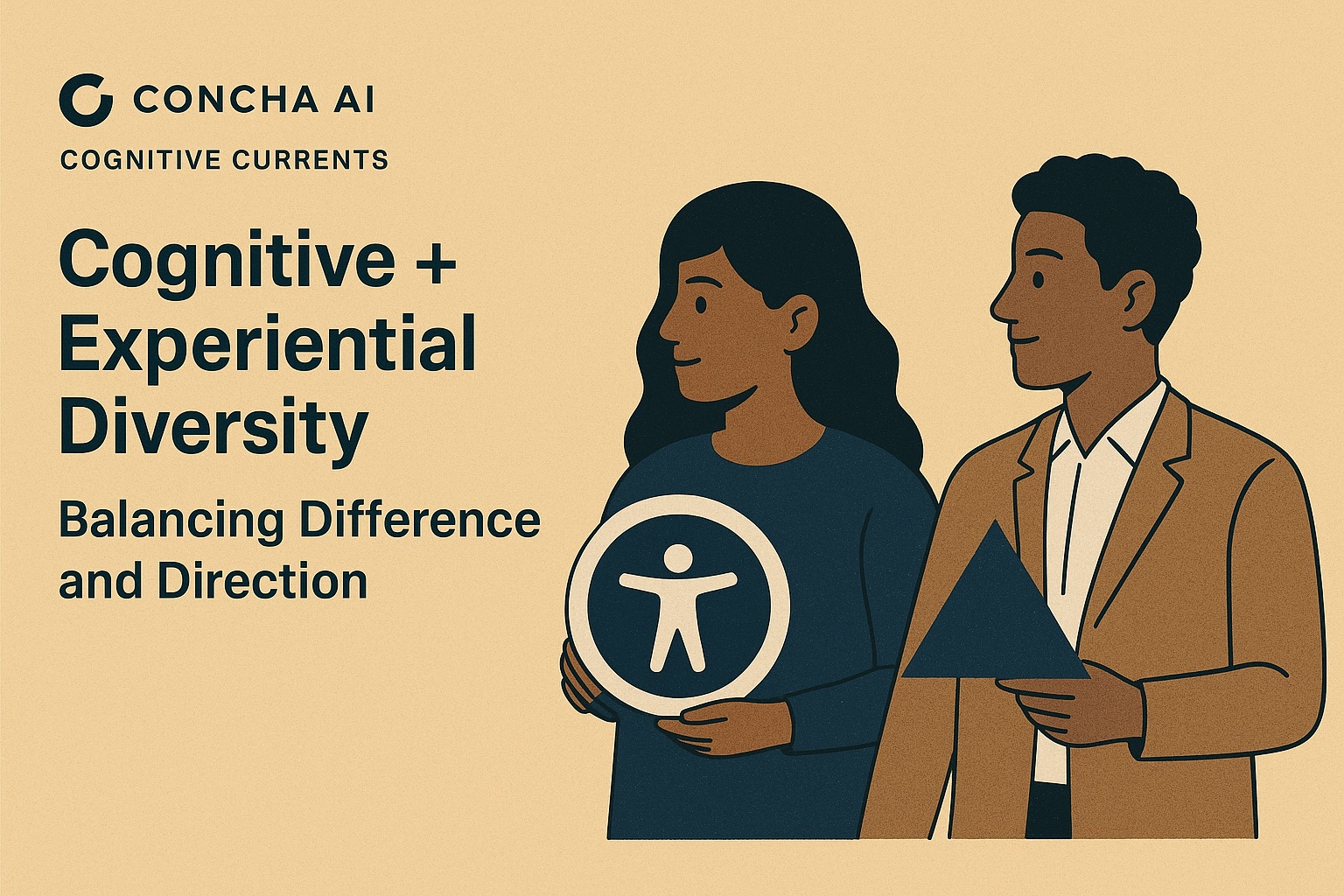
In most organisations, diversity has become a familiar ambition — but cognitive and experiential diversity remain the two least understood and least utilised sources of competitive advantage. Many leadership teams recruit for demographic inclusion yet default to homogeneity of thought, background, and decision-making patterns.
Cognitive and experiential diversity are not “nice to have” features. They are structural enablers of better strategy, stronger innovation, and more resilient organisations. But diversity alone is insufficient. What matters is the equilibrium between difference and direction — the ability to harness distinct perspectives toward a shared strategic outcome.
1. Cognitive Diversity: How People Think, Not Just Who They Are
Cognitive diversity focuses on the mental models individuals use to solve problems. Two people with similar backgrounds may think in completely different ways, and two people from different demographics may operate from the same mental patterns.
High-performing teams include varied cognitive traits:
- Analytical and intuitive thinkers
- Risk-sensitive and risk-tolerant profiles
- Detail-oriented and abstraction-focused individuals
- Fast decision-makers and deliberate sense-makers
- Pattern recognisers and procedural organisers
This mix strengthens resilience. When teams face novel situations, cognitive diversity expands the range of possible solutions instead of reinforcing the same comfort-zone reasoning.
2. Experiential Diversity: The Value of Lived Exposure
Experiential diversity shapes judgment. It comes from:
- Exposure to different industries
- Work across cultures
- Experience during crises
- Running growth environments vs. stabilisation ones
- Leadership at different scales and under different constraints
Experiential variety allows teams to compare, contrast, and synthesise across contexts — a capability increasingly valuable in a world where problems rarely fit neatly into single domains.
3. Without Direction, Diversity Fractures Instead of Elevates
The most common failure mode in diversity strategies is assuming difference will naturally harmonise. It won’t.
Diversity without direction produces:
- Fragmented discussions
- Competing priorities
- Slow decisions
- Misaligned expectations
Direction is not control — it is coherence. The role of leadership is to give the team a unified strategic north, then allow different minds and experiences to inform how to get there.
Great leaders create freedom within a framework.
4. The Productivity of Constructive Dissonance
Teams with cognitive and experiential diversity outperform others only when discomfort is skillfully managed.
High-performing teams share these practices:
- Normalising challenge without personalising it
- Encouraging debate with psychological safety
- Knowing when to open discussion and when to close it
- Integrating contradicting inputs into a coherent plan
- Rewarding clarity of thought, not conformity
Constructive dissonance is not conflict — it is the tension required for sharper thinking.
5. Using AI to Map and Utilise Team Diversity
AI tools can help organisations map:
- Thinking patterns
- Decision-making biases
- Experience portfolios
- Capability distribution
- Problem-solving strengths
- Team blind spots
This enables leaders to architect intentionally diverse teams rather than rely on random or surface-level diversity.
AI also ensures diversity is not reduced to identity — but understood through capability, cognition, and context.
6. Aligning Diversity With Strategy
The final step is integration.
Cognitive and experiential diversity must align with:
- The organisation’s strategic direction
- The complexity of the environment
- The decision velocity required
- The transformation stage the company is in
A hyper-growth environment needs cognitive fast movers and risk-tolerant profiles.
A regulatory transformation needs detail-oriented analytical thinkers.
A turnaround scenario requires experiential diversity from crisis-tested leaders.
Diversity must match the mission.
Conclusion: Diversity Becomes Power When It Has Purpose
Organisations that balance difference + direction achieve more creativity, more resilience, and more intelligent decisions.
The goal is not simply to bring different people in — but to bring different thinking together in a shared direction.
That is the essence of cognitive and experiential diversity.