Most organisations today stand at a delicate crossroads: the leadership pipelines are thinning, successor-readiness is inconsistent, and the expectations placed on future leaders have never been higher. Yet many companies still rely on outdated assumptions — equating experience with capability, tenure with readiness, and age with maturity.
To shape the next generation of leaders, we need to rethink how we evaluate potential. That requires shifting from “What have you done?” to “What are you capable of doing next?”
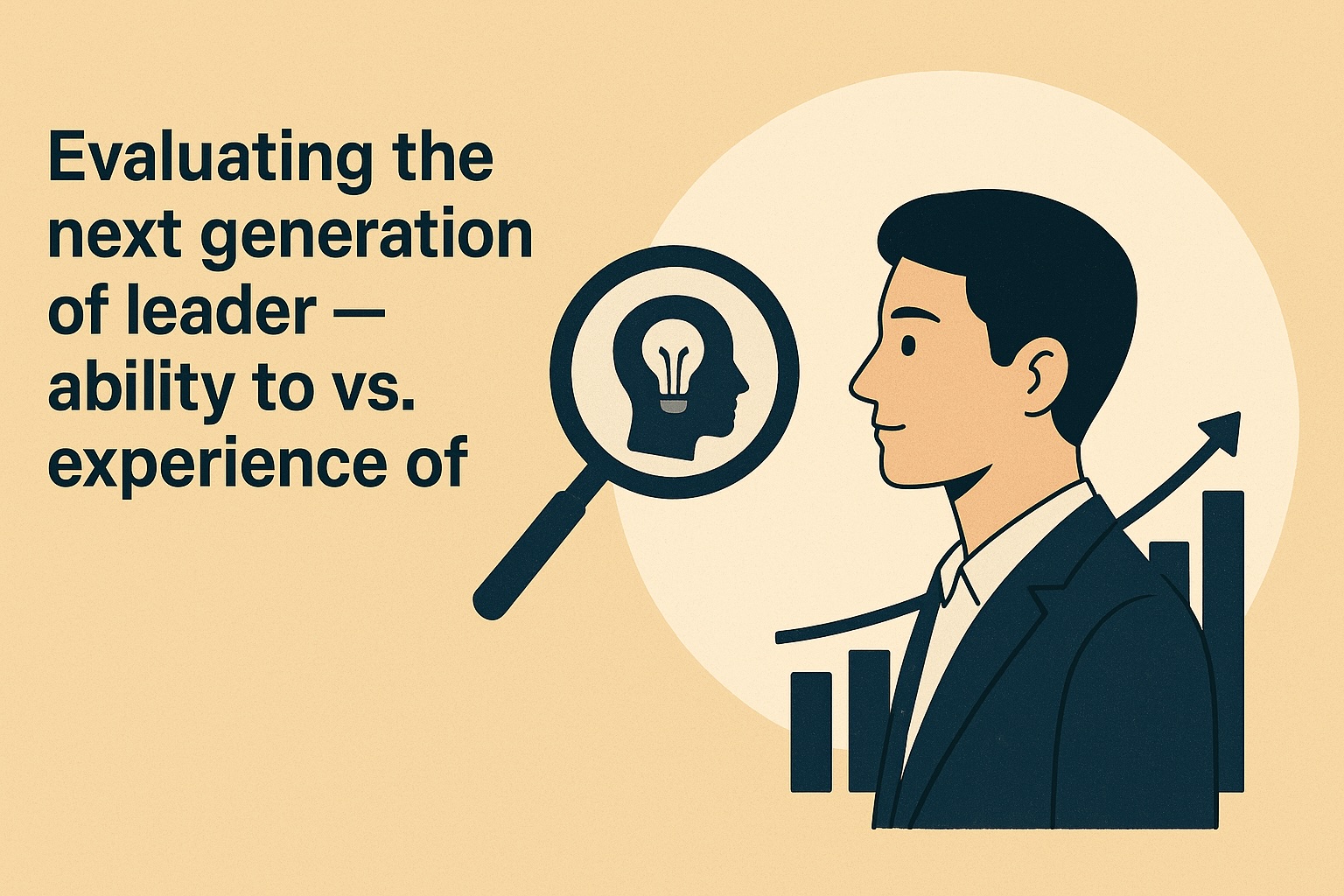
This distinction — ability to vs. experience of — defines the future of leadership assessment.
1. Experience is Historical. Ability is Directional.
Experience tells us where a person has been.
Ability tells us where they can go.
The old model trained leaders for predictability. But today’s world demands leaders who can navigate ambiguity, embrace continuous learning, and adapt at speed. Experience becomes less predictive when contexts shift faster than careers evolve.
The organisations winning today are those that:
- Assess learning velocity, not just tenure.
- Value pattern recognition over procedural memory.
- Identify curiosity as a capability, not a personality trait.
- Evaluate resilience in the face of uncertainty, not familiarity in stable environments.
Experience is still useful — but it is no longer the anchor. It is one data point among many.
2. The Leadership Gap Is Not Skills — It’s Adaptability
The most consistently accurate predictor of effective future leaders is adaptability, not accumulated experience.
High‐ability future leaders demonstrate:
- Cognitive flexibility
- Openness to new models and methods
- The capacity to unlearn outdated practices
- Comfort with technology as a strategic partner
- The ability to synthesise diverse data into direction
These traits do not require decades of experience — they require the right environments to emerge.
Organisations need mechanisms to spot these qualities early, develop them intentionally, and reward them visibly.
3. Rethinking Assessment: From Checklists to Signals
Most leadership assessments are still rooted in competency lists built for a different era — compliance, control, efficiency. The next generation needs a different lens.
Modern “ability to” signals include:
- Response to novel situations — not just known processes
- Speed of insight formation
- Cross-domain synthesis
- Quality of decision-making under incomplete information
- Willingness to challenge implicit assumptions
- Ability to integrate AI as part of their workflow
These signals require new evaluation tools: scenario-based simulations, problem-solving sprints, multi-source assessment, and AI-augmented cognitive insights.
4. The Experience Premium Still Matters — But Differently
Experience is still critical — but its value changes when viewed through a future-forward lens.
Instead of asking “Does this person have 15 years of experience?”, ask:
- What types of complexity have they navigated?
- Did those experiences form resilience or rigidity?
- Did they lead transformation or simply witness it?
- Did they adapt their leadership approach as contexts changed?
Experience should be evaluated through a dynamic filter, not a static checklist.
5. A New Leadership Archetype Is Emerging
The next generation of leaders are:
- Less hierarchical
- More collaborative
- Technologically fluent
- Comfortable with distributed intelligence
- Data-literate and emotionally intelligent
- Skilled at designing environments, not enforcing rules
These leaders are not just managers — they are architects of adaptability.
6. A Holistic Assessment Model for Future Leaders
To evaluate future leadership potential, organisations need a balanced capability model:
Ability to (Forward-Looking):
- Cognitive agility
- Learning velocity
- Adaptive thinking
- Systems awareness
- Scenario reasoning
- AI augmentation capability
Experience of (Backward-Looking):
- Exposure to complexity
- Transformation environments
- Leading through shifts
- Stakeholder negotiation
- Cultural intelligence
- Operational grounding
When these two dimensions combine, they create leaders who are both prepared and possible.
7. The Role of AI in Leadership Evaluation
AI enhances leadership assessment by:
- Reducing human bias
- Analysing behavioural patterns at scale
- Predicting adaptability potential
- Mapping cognitive strengths
- Simulating future role demands
- Identifying hidden high-potential individuals
The goal is not replacing human judgment — but augmenting it with clarity and depth.
Conclusion: The Leader of Tomorrow Is Built, Not Assumed
Evaluating future leaders requires a shift from nostalgia to foresight.
Experience will always tell a story — but ability shapes the next chapter.
The organisations that thrive will be those that:
- Look for potential earlier
- Develop adaptive capability intentionally
- Modernise how leadership is assessed
- Build cultures that reward learning, not just longevity
The next generation of leaders is already emerging — our responsibility is to identify them accurately, develop them systematically, and trust them intentionally.