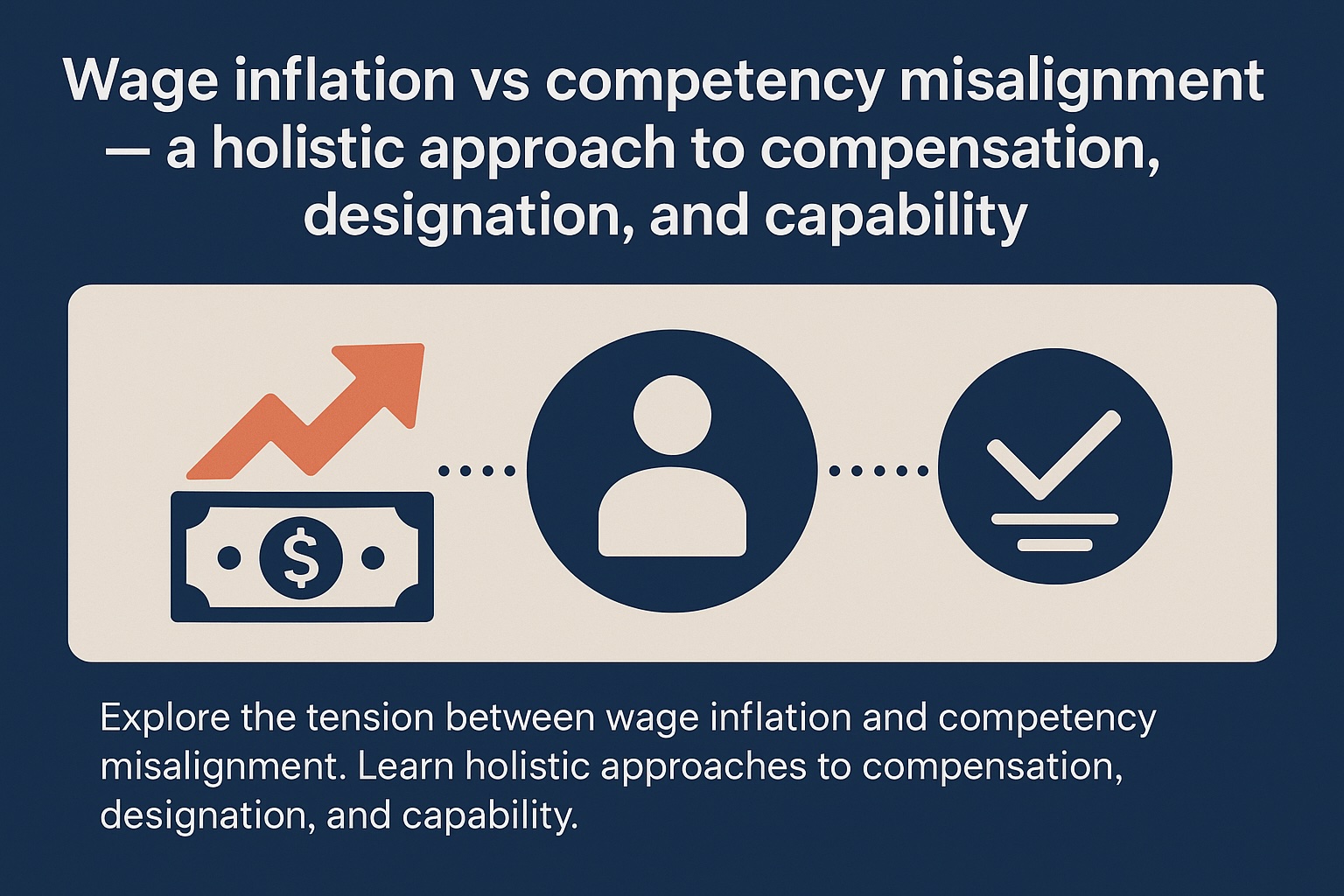
Across industries, organisations are facing a dual challenge: wage inflation driven by market pressure, and competency misalignment driven by outdated role structures, unclear expectations, and talent gaps.
Individually, each is disruptive. Together, they form one of the most complex people-management puzzles of the decade.
At Concha AI’s Cognitive Currents, we explore why this tension exists — and how leaders can adopt a holistic approach to compensation, designation, and capability that supports employee growth and organisational resilience.
The problem: Pay is rising, but capability isn’t keeping pace
Wage inflation often happens faster than capability development. Companies pay more to attract or retain talent, yet:
- Skills don’t always match the salary bracket
- Titles inflate without a corresponding increase in responsibility
- Teams experience inconsistency in performance
- Employees feel underprepared or overwhelmed
- Managers lack frameworks to justify pay differences
This creates a landscape where compensation signals seniority, but competency does not always confirm it.
The competency misalignment trap
Competency misalignment emerges when an employee’s skills and behaviours no longer align with:
- Their designation
- Their compensation level
- Their expected output
This misalignment is rarely intentional — it is a symptom of:
- Rapid hiring cycles
- Market-driven salary adjustments
- Overreliance on job titles
- Poorly defined career ladders
- Limited visibility into actual capability
- Legacy organisational structures
Over time, organisations end up with uneven performance distributions, overpaid underperformers, and underpaid high performers who become flight risks.
A holistic alternative: Integrating compensation, designation, and capability
To break this cycle, companies need an integrated approach where:
1. Compensation is data-driven and transparent
Instead of reactively adjusting salaries based on external pressure, companies should adopt:
- Market compensation benchmarking
- Skills-indexed pay bands
- Internal role equivalency frameworks
- Pay-for-impact rather than pay-for-presence
This ensures salaries reflect real competitive value, not arbitrary inflation.
2. Designations reflect real organisational needs
Title inflation is a silent organisational disruptor.
A healthy designation model focuses on:
- Scope of responsibility
- Decision-making authority
- Impact radius
- Leadership vs technical contribution
- Clear progression without unnecessary title jumps
Employees should see vertical and lateral pathways that reward mastery, not just hierarchy.
3. Capabilities are defined, assessed, and developed continuously
This is where most organisations struggle — but also where the greatest gains lie.
A capability-centric model includes:
- Defined behavioural and technical competencies
- Regular capability assessments
- Growth plans tied to measurable outcomes
- AI-assisted skill gap analysis
- Training aligned to future business requirements
When capability is a living, measurable aspect of HR strategy, decisions become objective rather than subjective.
The three pillars unified
When these three elements work together, organisations achieve:
✔ Fair compensation
Aligned with market reality and internal value creation.
✔ Accurate designation
Titles that mean something — internally and externally.
✔ Capability clarity
Teams built on strength, not assumption.
This is the foundation of a modern workforce architecture.
The role of AI in solving the imbalance
AI-driven workforce tools — including emerging solutions from Concha AI — are enabling organisations to:
- Analyse competency gaps at scale
- Predict future capability requirements
- Recommend upskilling pathways
- Benchmark compensation dynamically
- Model workforce scenario planning
- Align people strategy with business strategy
Where traditional HR analytics were reactive, AI makes the system proactive.
Why this matters now
In a world shaped by automation, shifting demographics, and geopolitical volatility, the companies that thrive will be those that:
- Reward fairly
- Develop intentionally
- Structure their workforce intelligently
Wage inflation and competency gaps are symptoms, not the problem. The core issue is misalignment — and solving it requires a holistic, integrated approach.
At Concha AI, we believe the future of organisational performance lies not just in hiring the right people, but in building the right structures around them.
Final thought
A company’s ability to grow is directly tied to its ability to align compensation, designation, and capability. Achieving this balance is not merely an HR exercise — it is a strategic transformation.
Leaders who address this now will build teams that are not just well-paid or well-titled, but truly well-equipped.